Connection level
3 direct connectionsCrop Circles unite art, hoax, geometry, English fields, UFOs, Wiltshire, Doug Bower, Dave Chorley and the question of how anonymous symbols become collective mystery.
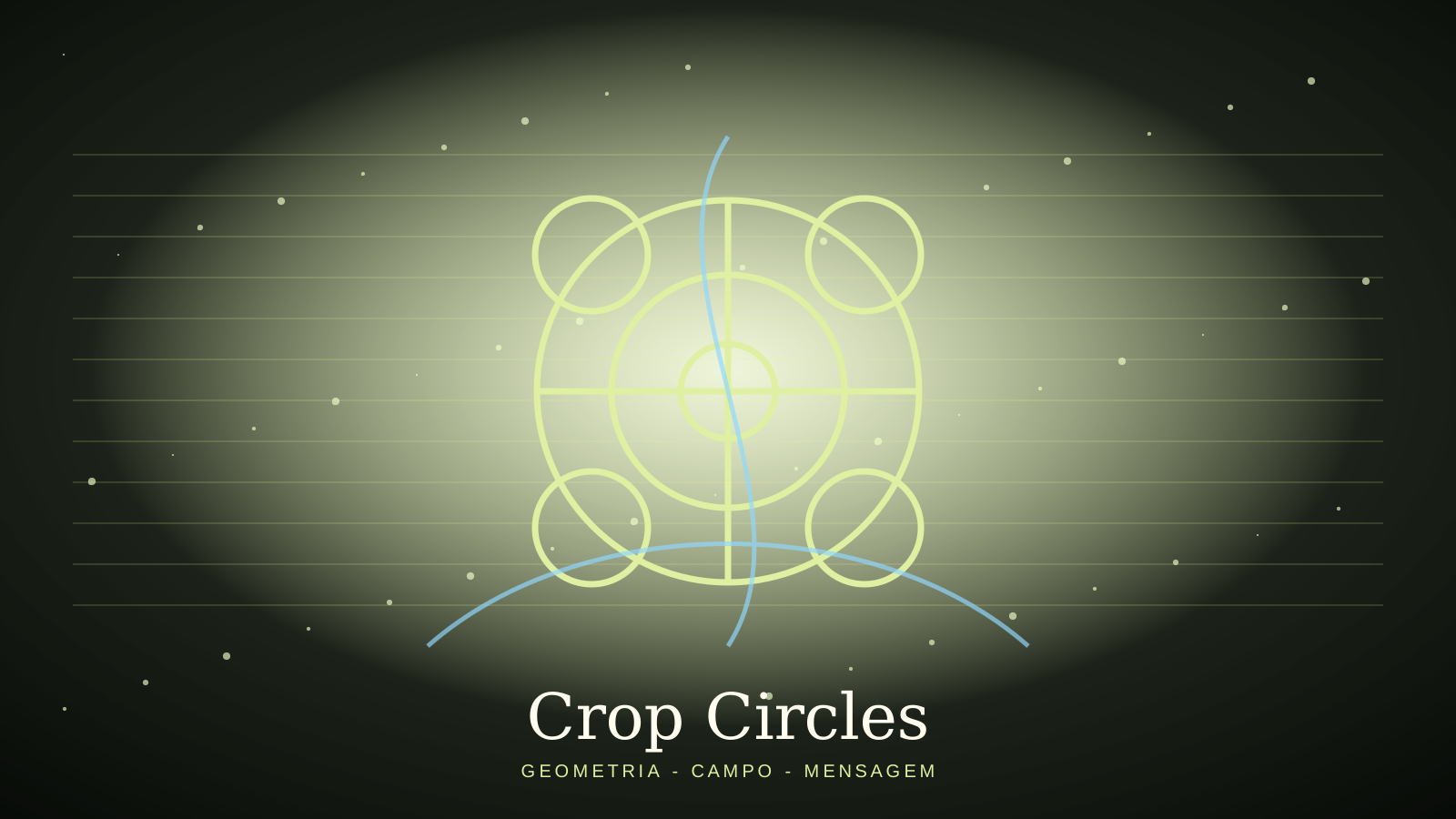
Geometry appearing overnight
Crop circles are designs formed by bent or flattened plants in fields, usually wheat, barley or other crops. From the ground, they may look like strange paths. From above, they become mandalas, fractals, spirals, messages, diagrams and geometric images that seem too large to belong to a prank.
Britannica defines the phenomenon as geometric patterns in crops, often found in southern England, and notes that many have been proven to be made by humans. That already places the theme correctly: this is not pure mystery, but a mixture of land art, anonymous performance, ufology, tourism, hoax, faith and enchantment.
In AwakenMap, Crop Circles is a World theme because it happens in real fields, with real farmers, real losses and specific landscapes. But it is also Knowledge and Cosmic because it uses geometry, symbols, UFOs, frequency, communication and collective imagination.
Wiltshire and the landscape of mystery
The phenomenon gained force especially in southern England, in regions such as Wiltshire, Hampshire and Dorset. This is not a detail. Wiltshire is already charged by Stonehenge, Avebury, Silbury Hill, Neolithic tombs, sacred hills and a landscape where archaeology and myth have met for centuries.
When a design appears near Stonehenge or Avebury, it inherits part of the aura of those monuments. The modern field begins to dialogue with a prehistoric landscape. Even if the design is human, its location turns the gesture into contemporary ritual: an anonymous mark made on a land already symbolically charged.
National Geographic described tourism linked to these designs as a scene of its own, with visitors, photographers, researchers, the curious and people seeking spiritual experience. In other words: crop circles are not only objects. They create pilgrimage.
Doug Bower, Dave Chorley and the art of the hoax
In 1991, Doug Bower and Dave Chorley claimed to have created many crop circles in England using simple tools such as planks, ropes and planning. According to Smithsonian, they began in 1976 trying to create a kind of 'flying saucer nest' in a Wiltshire field, without imagining it would become a global phenomenon.
The revelation did not end the theme. On the contrary, it made it more interesting. If two men could create convincing designs at night, many circles could be human works. But the next question became even better: why did so many people want to believe they were not human?
Bower and Chorley showed that a hoax can become folk art, and that a prank can become cultural myth. This does not absolve damage to farmers or deliberate deception, but it reveals something deep about anonymous authorship, desire for mystery and the power of images seen from above.
How a crop circle can be made
Many designs can be made with simple techniques: ropes to mark radii, planks to flatten plants, center points, careful walking through existing tracks and coordinated work at night. With practice, groups can create very complex forms without impossible technology.
That explanation does not diminish the skill involved. On the contrary: good crop circles require practical geometry, planning, visual sense, physical endurance and control of time. The difficulty is real, but difficulty is not proof of extraterrestrial origin.
Part of the beauty of the phenomenon lies in this paradox. Something made with wood, rope and footsteps can look like a cosmic message when photographed from the air at dawn. Perspective changes meaning.
The UFO reading
The association with UFOs came early because the first modern circles were interpreted as possible landing marks or signs of nonhuman intelligence. Over time, the designs became more complex and began to be read as codes, messages from star civilizations, planetary warnings or symbolic communications.
This reading becomes stronger when the designs use mathematical forms, spirals, stars, fractals, humanoid figures or apparent references to astronomy. The human mind recognizes patterns and seeks a sender. When a message appears without signature, imagination looks for a greater author.
In AwakenMap, the UFO reading should be presented as cultural and spiritual layer, not automatic conclusion. There are reports, experiences and interpretations; but the existence of complex designs does not prove extraterrestrial origin by itself.
Sacred geometry or human design?
Many crop circles use proportion, symmetry, repetition and forms associated with sacred geometry. This connects them to mandalas, rose windows, labyrinths, cosmological diagrams and ritual art. Even when made by people, they can produce strong visual experience because they work with forms the body perceives as order.
The question 'is it human or sacred?' may be poorly framed. Humans have made sacred art for millennia. A human design can be spiritually meaningful without being supernatural. The problem arises when beauty is used as an argument of impossibility: 'it is too beautiful to have been made by humans'.
That phrase repeats a common error in ancient ruins: underestimating human creativity. Crop circles show that humans also enjoy creating riddles for other humans.
Physical signs and extraordinary claims
Defenders of anomalous origins often cite plants bent without breaking, elongated nodes, magnetic changes, radiation, equipment failures, lights in the sky and effects on animals or people. Some of these claims deserve to be recorded as part of the history of the phenomenon.
But recording is not confirming. To turn a claim into evidence, controlled collection, comparison with ordinary fields, exclusion of human intervention, publication, replication and independent review would be needed. Without that, interesting signs may be observational error, natural effect, selective interpretation or part of myth-making.
Critical reading does not need to deny every experience. It only asks that each kind of claim be treated with the appropriate level of proof.
Anonymous art, internet and symbolic contagion
Crop circles anticipated something the internet later made common: anonymous viral images, open to interpretation, created to circulate. A design appears, someone photographs it from above, researchers discuss it, websites replicate it, groups interpret it, other artists respond with even more complex designs.
This symbolic contagion explains the evolution of the phenomenon. Simple circles gave way to pictograms, fractals, perspective cubes, binary messages and enormous compositions. Artistic competition and public expectation pushed human makers to create increasingly impressive forms.
Even if many are made by artists, the mystery does not disappear completely. It moves. The riddle ceases to be 'which craft made this?' and becomes 'why can this anonymous form reorganize the imagination of so many people?'.
Farmers, damage and responsibility
There is an unromantic layer: crop circles happen on agricultural property. They can damage crops, attract visitors without permission, create costs, compact soil and turn farmers' work into a stage for someone else's mystery. Beauty seen from above may have a cost on the ground.
This point matters for a mature page. Spirituality without responsibility becomes consumption. If a field is private, entering without permission is trespass. If a crop is someone's work, turning it into a canvas without consent is an ethical problem.
AwakenMap can recognize the fascination of the designs without erasing those who live and work in the landscape where they appear.
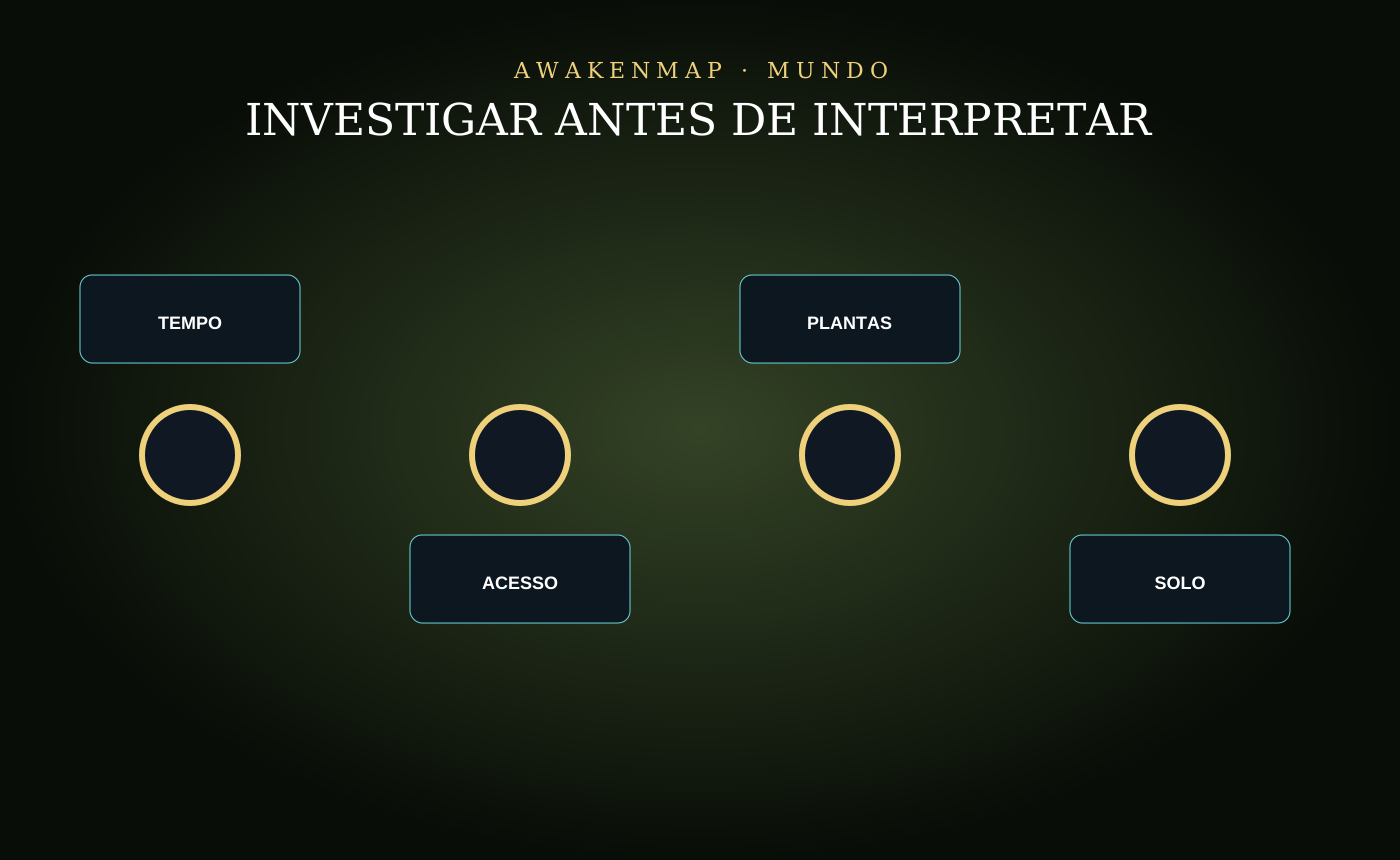
From simple circles to complex pictograms
The early British cases that gained wide attention were relatively simple circles. From the late 1980s and early 1990s, formations became pictograms, fractals, spirals and large-scale compositions. This evolution follows both creator skill and growing public expectation.
Complexity does not automatically distinguish human from unknown origin. Artist groups learned to use teams, measurements, reference lines and advance planning. Darkness, tall crops and aerial photography hide small errors that would be obvious in a technical drawing.
Aerial photography and changing perception
Crop circles are designed to be seen from above, but for decades depended on aircraft, helicopters and towers to reveal their form. Drones transformed documentation by rapidly recording detail, access paths and later alteration.
Beautiful images can also remove context. A vertical frame may omit nearby roads, tractor lines, people or damage. Investigation should preserve ground photographs, coordinates, time and temporal sequence, not only the most impressive final image.
How claims of anomalies should be tested
Reports cite elongated nodes, plants bent without breaking, altered germination, magnetic particles and electromagnetic change. To evaluate such claims, samples inside the formation must be compared with equivalent controls outside it, collected and analysed blind.
Heat, natural growth, moisture, soil, farm machinery and trampling also alter plants. A result gains strength when methods, samples and statistics are published and independently reproduced. “Unusual” begins investigation; it does not complete it. Transparent data also allows later researchers to test competing explanations without relying on authority.
Crop Circles in AwakenMap
In AwakenMap, Crop Circles connects to UFOs, Ley Lines, Sacred Geometry, Stonehenge, Avebury, Stone Circles, Frequency, Vibration, Great Awakening and symbolic communication. It is a perfect node for showing how the physical World and cosmic imagination meet.
As World, the theme is field, crop, property, landscape and tourism. As Knowledge, it is history of the phenomenon, design, hoax, investigation and visual culture. As Cosmic, it is message, geometry, contact, synchronicity and desire for communication with greater intelligences.
A good page about Crop Circles should not simply say 'all fake' or 'all alien'. The phenomenon is more interesting than that: a strange collaboration among artists, believers, skeptics, farmers, tourists, photographers, ufologists and the landscape itself.
How to read this theme
Start by asking where the design appeared, when, who photographed it, whether the farmer allowed access, whether there are entry tracks, whether the pattern can be produced by human technique and whether independent data exists for physical signs.
Then observe the symbolic layer: why does that form move people? Does it use sacred geometry? Does it dialogue with nearby monuments? Does it feel like message, mandala, joke, signature or provocation?
Crop circles teach an uncomfortable and beautiful lesson: not every mystery has to come from space to be deep. Sometimes the mystery is our own desire to receive a message.
Critical reading
Crop Circles should be read as anonymous art, hoax, spiritual experience, design and UFO culture. The beauty of the phenomenon does not require alien origin; it requires an honest reading of what humans do when they want to create mystery.
References and starting points
- Britannica - Crop circle
- Smithsonian Magazine - Crop Circles: The Art of the Hoax
- National Geographic - Crop circle tourism in Wiltshire
- Skeptical Inquirer - The Crop-Circle Phenomenon
- EBSCO - Crop Circle overview
- Center for Inquiry - Crop Circles Evolve
FAQ
Are crop circles made by aliens?
There is no robust proof of that. Many have been proven human-made, although spiritual, artistic and ufological interpretations continue.
Why do they still matter?
Because they show how geometry, anonymity, landscape and desire for contact can transform a farm field into a collective symbol.
Keep exploring

Join the conversation
Comments are moderated. Keep the discussion respectful and distinguish evidence, interpretation and personal experience.