
Connection level
2 direct connectionsThe Bosnian Pyramid in Visoko unites natural hills, Semir Osmanagic's claims, spiritual tourism, pseudoarchaeology, national pride and the question of how mystery becomes cultural economy.
Visoko and the mountain that became a pyramid
The so-called Bosnian Pyramid lies in the Visoko region of Bosnia and Herzegovina, where a hill known as Visocica gained global fame after Semir Osmanagic claimed in 2005 that it was the largest and oldest pyramid built by humans. The hill became known as the Pyramid of the Sun, while other forms in the landscape received names such as Pyramid of the Moon, Pyramid of the Dragon and Valley of the Pyramids.
The theme is fascinating because it is not only a question about stone. It involves archaeology, geology, tourism, national trauma, New Age spirituality, postwar pride, local economy and conflict between academic researchers and defenders of alternative history. The Bosnian Pyramid is a case in which landscape became narrative.
In AwakenMap, this node needs to be treated with great care. It belongs to World because it is a physical, visitable, photographed and excavated place. But it also belongs to the field of ideas because it shows how a triangular shape can ignite expectations about lost civilizations, energy, tunnels, healing and forgotten past.
Semir Osmanagic's claim
Semir Osmanagic, a Bosnian-American businessman and independent researcher, proposed that Visocica and other hills around Visoko were very ancient artificial structures, possibly older than known civilizations. His narratives include cardinal alignments, blocks, tunnels, energy, ancient concrete and a civilization capable of monumental works.
The proposal seduced the public because it promised a powerful inversion: Bosnia, marked by recent war and historical pain, would hold a monumental civilizational origin older than Egypt. That promise is not only archaeological; it is emotional and political. It offers grandeur where there was wound.
Osmanagic's strength lies in telling a simple, visual and mobilizing story. The problem is that a strong story does not replace method. Claims about artificial pyramids require controlled excavation, stratigraphy, dating, publication, independent review and rigorous geological comparison.
What academic criticism points out
Critical archaeologists and geologists argue that the hills of Visoko are natural formations, not constructed pyramids. Robert Schoch, a geologist known even for defending alternative readings of the Sphinx, visited the region and concluded that there were no pyramids there, but rather natural forms and real archaeological heritage deserving care.
Smithsonian published a report showing how specialists treated the hypothesis as pseudoarchaeology and how the project gained popular support despite academic rejection. The concern was not only theoretical: poorly conducted excavations could damage medieval, Roman and Neolithic remains existing in the region.
This point is essential. Criticizing the Bosnian Pyramid does not mean saying Visoko has no history. On the contrary: the region has real layers, including medieval fortifications, possible ancient occupations and local heritage. The risk is that a spectacular narrative runs over real archaeology.
Flatirons, natural geometry and illusion of form
One frequent geological explanation for the shape of Visocica is the presence of natural features that can produce inclined and triangular faces. Nature creates geometric forms more often than popular imagination assumes: strata, fractures, differential erosion, regular slopes and drainage lines can look like architecture.
The human eye is trained to recognize patterns. When a hill has a triangular face, striking orientation and defined top, the mind completes the image: pyramid. This mechanism is not stupidity; it is a normal cognitive tendency. The problem arises when visual resemblance becomes sufficient proof.
A mature reading asks: is the form merely similar, or does it show clear signs of construction? Are there carved blocks in original context? Are there foundations, tools, cultural layers, consistent dates, occupation remains and construction sequence? Without this, visual geometry remains suggestive, not conclusive.
Ravne tunnels and the underground experience
The Ravne tunnels are central to tourism and the spiritual narrative in Visoko. Visitors report energetic sensations, pure air, meditation, negative ions, healing, silence and an experience of descent into the earth. For many, the tunnels are more convincing than the hill itself.
From a critical perspective, tunnels and passages must be studied carefully: origin, age, function, modern excavations, recent changes, safety and archaeological context. A real tunnel does not automatically prove an ancient pyramid. It may have its own natural, medieval, mining, modern or mixed history.
In AwakenMap, Ravne should appear as a layer of experience. People may live something meaningful there. But personal experience does not replace archaeological proof about the origin of the whole complex.
Tourism, healing and New Age pilgrimage
The Bosnian Pyramid became a destination for alternative tourism. Some visitors arrive through archaeological curiosity, others through spirituality, meditation, energy reports or healing. The region created an economy around mystery: guides, visits, shops, events, volunteer work and transformation narratives.
The article available through JSTOR describes Visoko as a New Age pilgrimage site where the landscape is reinterpreted through contemporary spiritual practices. This is not a side detail; it is part of the phenomenon. Even if the pyramid is not proven, belief has already produced a real social place.
This is one of the most interesting layers: myth creates concrete effects. People travel, spend, work, meditate, argue, defend and transform around it. The question ceases to be only 'is it a pyramid?' and becomes 'what does this imagined pyramid do to a community?'.
Nationalism, trauma and the need for grandeur
Bosnia and Herzegovina carries deep wounds from the war of the 1990s. In that context, the promise of a monumental past can gain emotional weight. A discovery placing Bosnia at the center of world civilizational origins would offer pride, international attention and a kind of symbolic repair.
Smithsonian showed how the hypothesis was embraced by politicians, local media and part of the public, while critics were accused of attacking national pride. This pattern is common in pseudoarchaeology: when a theory becomes identity, disagreeing with it begins to look like betrayal.
Critical reading needs to be human. It is not enough to laugh at belief. We need to understand why it took hold. Wounded peoples seek narratives of grandeur. The problem is that real heritage can be sacrificed when emotional need demands an answer too grand.
Supportive studies and the persistent dispute
Defenders of the project continue publishing favorable materials and studies, including geometric, topographic, electromagnetic analyses and interpretations about possible human intervention. Some recent texts try to reopen the discussion by presenting Visocica as an unusual formation not fully explained by natural processes.
These materials should be read, but with criteria. Who financed or organized the research? Were the data reviewed by independent specialists? Do the conclusions exceed what the measurements allow? Does geometric regularity prove construction or merely select a visually impressive face?
AwakenMap's balance is to let the reader know that an active defense of the thesis exists, without hiding that the predominant academic position remains skeptical and that classification as an artificial pyramid is not archaeological consensus.
Pseudoarchaeology and the danger of erasing the real
Pseudoarchaeology is not only a wrong theory. It can produce harm: excavation without method, erosion of real sites, public confusion, irresponsible tourism, discrediting researchers and erasing historical communities. When everything becomes lost civilization, the concrete past loses sharpness.
In the case of Visoko, several critics warned that the region has authentic heritage deserving protection. Turning everything into proof of a tens-of-thousands-year-old pyramid can obscure medieval fortifications, Roman remains and much better supported occupations.
This does not mean closing the subject. It means putting the question in the right place. If something is artificial, let it be demonstrated through method. If there is real heritage, let it be preserved. If there is myth, let it be studied as myth.
Shape is not structure
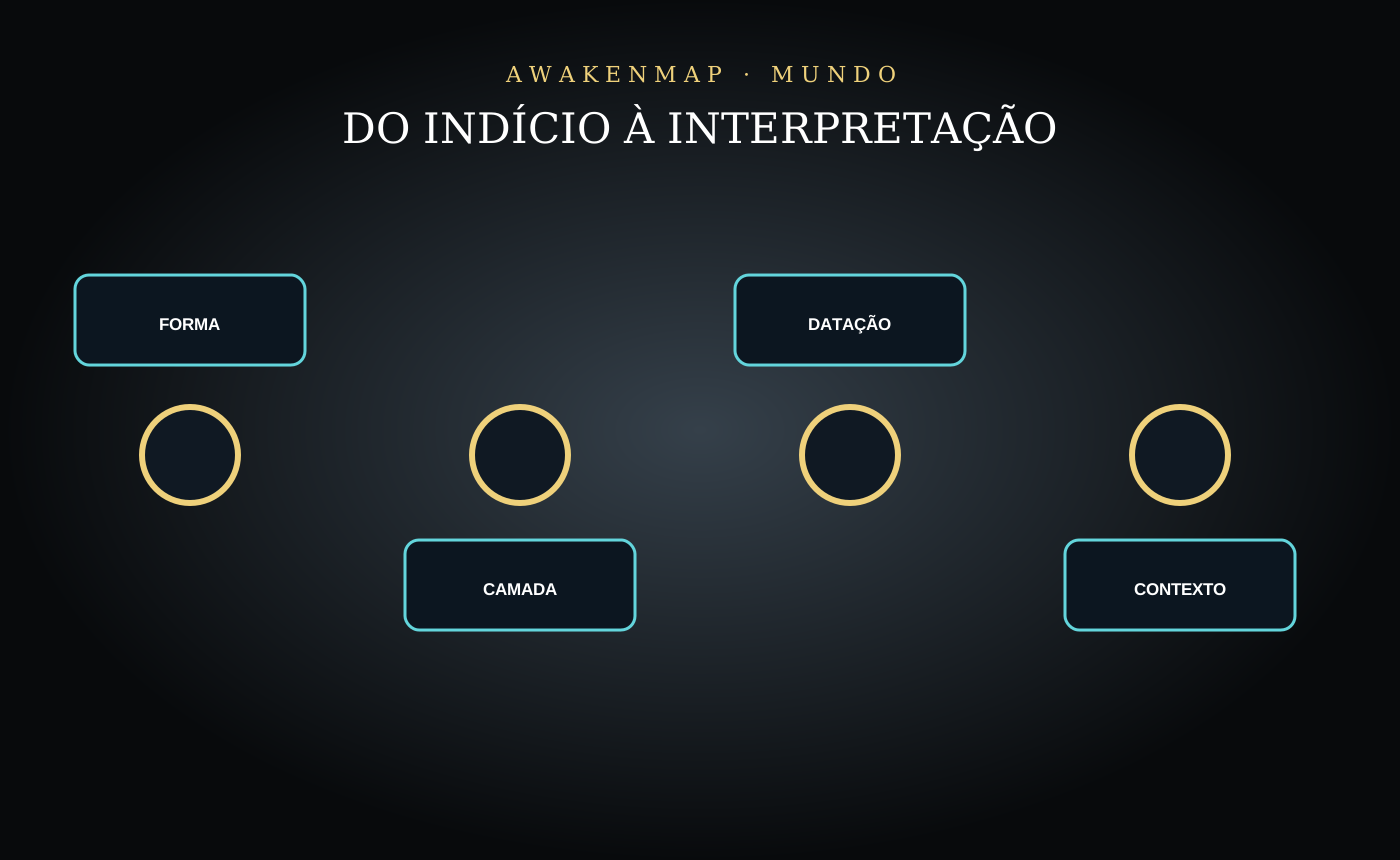
A mountain may present triangular faces through erosion, stratification and the orientation of rock layers. Recognizing a familiar form begins observation, but it does not prove that the entire mass was designed, faced or built by people.
To distinguish a monument from natural relief, archaeologists seek organized walls, foundations, work areas, tools, cultural deposits and stratigraphic relationships. Blocks or surfaces resembling concrete require petrographic analysis and context, not photographic appearance alone.
Dating: what exactly was dated?
Very early dates associated with the site circulate as the age of the alleged pyramid. Yet organic material found upon, within or near a formation does not automatically date the entire structure. The sample must be tied to a specific human action rather than later sediment.
This principle applies to every controversial site: a date answers only the question connected to its sample. Soil, timber, concretion, tunnel and wall may have different histories. Without clear provenance, impressive numbers produce more noise than chronology.
Ravne tunnels: excavation and interpretation
The Ravne tunnels are a real physical experience, but their origin and modification must be separated from claims of a prehistoric network. Passages may result from mining, modern excavation, geological processes or combined phases.
Continuous material removal changes the object under investigation. Independent documentation, stratigraphic profiles, plans and records of each intervention are therefore essential. A tunnel enlarged during research cannot later be treated as though its entire shape survived intact from antiquity.
Real heritage around Visoko
The region contains medieval history, settlements and genuine archaeological material. When one monumental narrative dominates the landscape, proven sites risk receiving less attention or being reinterpreted to serve the larger theory.
The editorial challenge is neither to mock visitors nor erase local archaeology. Visoko can be studied as a geological, tourist, spiritual and social phenomenon while pyramid claims are tested by ordinary archaeological standards.
Bosnian Pyramid in AwakenMap
In AwakenMap, the Bosnian Pyramid connects to Megalithic Sites, Pyramids, Ancient Ruins, Atlantis/Lemuria/Mu, Hollow Earth, Agartha, Ley Lines, telluric energy and spiritual tourism. It is a perfect case of conflict between evidence, desire, geographic form and alternative narrative.
As World, it is hill, tunnel, city, tourism, soil, rock and heritage. As Knowledge, it is archaeology, geology, pseudoarchaeology, nationalism and methodology. As Cosmic, it is pilgrimage, energy, healing, descent into the interior and search for lost origin.
A premium page on the theme should not simply say 'false' or repeat promotional claims. It should show why the claim fascinates, why many specialists disagree, what real heritage exists there and how a hill can become the center of a global mythology.
How to read this theme
Start by separating three questions. First: is the hill an artificial pyramid? That requires strong geological and archaeological evidence. Second: does Visoko have real historical heritage? Yes, and it deserves care. Third: has the Bosnian Pyramid become a real cultural and spiritual phenomenon? Yes, even if the archaeological thesis is not proven.
When you find a claim, ask whether it distinguishes natural form from construction, whether there is dating, context, independent publication and preservation of archaeological layers. Also ask whether the narrative respects local history or merely uses Bosnia as a stage for global fantasy.
The Bosnian Pyramid teaches that mystery does not live only in stones. Often, it lives in the human need to transform landscape into destiny.
Critical reading
The Bosnian Pyramid should be read as real landscape, controversial claim, tourism phenomenon and modern myth. The beauty of the case lies in separating geology, archaeology, national identity, spiritual experience and promotion.
References and starting points
- Smithsonian Magazine - The Mystery of Bosnia's Ancient Pyramids
- Robert M. Schoch - The Bosnian Pyramids
- Archaeology Magazine archive - Bosnian Pyramids / UNESCO correspondence
- Public Anthropologist / JSTOR - The Bosnian Pyramid Phenomenon
- Journal of Biomedical Research & Environmental Sciences - Multidisciplinary Evaluation of the Pyramid-Shaped Formation
- Visit Visoko - Bosnian Pyramid tourism
FAQ
Is the Bosnian Pyramid proven?
There is no archaeological consensus that Visocica is an artificial pyramid. The predominant academic position interprets the hills as natural formations, although defenders continue proposing favorable studies and arguments.
Is the theme still worth studying?
Yes. The case reveals much about pseudoarchaeology, spiritual tourism, national pride, historical trauma and the way landscapes become contemporary myths.
Keep exploring
Join the conversation
Comments are moderated. Keep the discussion respectful and distinguish evidence, interpretation and personal experience.