Connection level
5 direct connectionsManifestation is the passage between desire, inner image, intention, decision and concrete form; a bridge between modern spirituality, action psychology and responsibility.
Manifesting is giving body to the invisible
Manifestation has become one of the central words of contemporary spirituality. It appears in intention journals, new moon rituals, affirmations, visualizations, vision boards, abundance practices and teachings about frequency. In its simplest form, to manifest means to transform an inner possibility into lived reality.
That definition is richer than it seems. A house first exists as desire, drawing, budget, decision and effort before it exists as a wall. A book is born as restlessness before it becomes pages. A life change begins as discomfort, image, courage, plan and gesture. In this sense, everyone manifests all the time: we give form to what we sustain through attention, choice and action.
The problem begins when manifestation stops meaning embodiment and starts meaning magical control of the world. The page needs to preserve the power of the word without selling the fantasy that everything obeys individual desire.
The difference between manifestation and the Law of Attraction
Manifestation and the Law of Attraction walk together, but they are not identical. The Law of Attraction usually states a rule: like attracts like, thoughts and feelings would attract equivalent experiences. Manifestation is broader: it describes the process by which something leaves the imagined field and gains form.
A person can practice manifestation without believing that the universe automatically delivers what they visualize. They can use intention to choose direction, visualization to organize focus, writing to clarify desire, planning to create a path and action to test reality. This version is less spectacular, but much stronger.
In AwakenMap, Manifestation should be the practical node of the theme. It asks: after desire has been named, what form does it ask for? What price does it require? What renunciation accompanies this choice? What needs to be done today so the image does not remain trapped in the mental field?
Modern spiritual roots
Current manifestation language has roots in New Thought and the New Age. Britannica describes New Thought as a mind-healing movement born in the nineteenth-century United States, based on religious and metaphysical assumptions about mind, faith and transformation. The New Age, in turn, spread a spirituality of healing, personal expansion and inner transformation from the 1970s and 1980s onward.
This history helps explain why manifestation mixes so many languages: prayer, energy, visualization, frequency, positive thinking, prosperity, self-knowledge, popular psychology and metaphysics. It does not belong to a single tradition. It is a crossroads word.
For this reason, reading must be careful. The same practice may be lived as prayer by one person, as mental training by another and as energetic technology by a third. Meaning changes according to the inner map of the practitioner.
Desire is not mere whim
Manifestation begins with desire, but desire is not only whim. Desire may be the symptom of a deep lack, a creative call, compensation for a wound, legitimate ambition, vanity, intuition or escape. Before manifesting, it is worth asking: where does this wanting come from?
Much spiritual frustration comes from trying to manifest desires that were never examined. A person wants wealth, but perhaps they want safety. They want fame, but perhaps they want to be seen. They want a relationship, but perhaps they want abandonment repaired. They want an extraordinary life, but perhaps they cannot sit quietly with ordinary life.
Manifestation matures when desire is listened to, not blindly obeyed. Sometimes it shows a path. Sometimes it shows a wound. Sometimes it shows a fantasy inherited from culture. Discerning this is part of the practice.
Inner image and direction
Visualization can be powerful because the mind organizes itself through images. When someone clearly imagines a life, body, project or conversation, they begin creating a pattern of orientation. The image works as north: it helps notice opportunities, reduce dispersion and rehearse responses.
But the inner image needs to remain alive, not rigid. If it becomes obsession, the person begins forcing reality to fit the script. A good symbol orients without imprisoning. It gives direction, but allows updating.
The question is not only can I imagine it? It is: does this image make me more present or more anxious? Does it call me to act or trap me in fantasy? Does it open the future or narrow life around a demand?
What action psychology adds
Research on behavior change helps separate useful manifestation from passive fantasy. Mental contrasting, associated with Gabriele Oettingen, proposes joining desired future and real obstacle. The idea is simple and demanding: see what you want, see what blocks it and then choose a concrete path.
Another important field is implementation intentions: if X happens, then I will do Y plans. Studies on goal achievement show that turning intention into an action trigger increases the likelihood of performing desired behaviors. This is manifestation without mysticism: a bridge between image and gesture.
Spirituality can learn from this. It is not enough to write I manifest health. One must ask: if I am tired tomorrow, what choice will I make? If I receive criticism, how will I respond? If fear appears, what is the next minimum step?
Inspired action and avoided action
Many teachings speak of inspired action: acting when there is inner alignment, intuition and flow. This idea has value because not every action is born from anxiety. Sometimes the body knows it is time. Sometimes an opportunity asks for a quick response. Sometimes there is a clear feeling of yes.
But inspired action can become an excuse not to act when the practice requires discipline. Not every important step arrives with brightness. Some arrive as bureaucracy, training, difficult conversation, budget, asking for help, revision, study, routine. The sacred also lives in what does not look magical.
Adult manifestation learns to distinguish flow from avoidance. If a person acts only when they feel euphoria, perhaps they are seeking an emotional state, not transformation.
When manifestation becomes denial
There is a delicate point: some people use manifestation to deny pain. They avoid speaking of grief so they do not lower frequency. They ignore financial problems so they do not feed scarcity. They refuse diagnosis, limit or conflict because they want to maintain a positive vibration. This is not mature spirituality; it is avoidance with luminous language.
Reality is not transformed when denied. It is transformed when met with presence. Grief needs space. Debt needs numbers. The body needs care. Conflict needs conversation. Fear needs to be heard enough to stop governing.
Manifesting is not pretending everything is fine. It is choosing what form we want to give life while looking at what exists without anesthesia.
The shadow of the abundance promise
Manifestation has been heavily captured by the promise of material abundance. Money, house, travel, ideal relationship and success appear as proofs of alignment. This can motivate, but it also creates showcase spirituality: whoever manifests much would be more evolved; whoever suffers would be misaligned.
This reading is poor. Abundance can include resources, but also time, health, friendship, silence, courage, creativity, learning, dignity and inner freedom. A person may manifest a truer life and, for that very reason, let go of certain status symbols.
The important question is not only what do I want to attract? It is: what kind of human being do I need to become to sustain what I ask for? And what does this request reveal about my relation to value, fear and belonging?
Co-creation is not omnipotence
Many practitioners use the word co-creation. It is better than control, because it recognizes that reality is not born only from the individual. We manifest inside bodies, families, economies, cultures, ecosystems, histories and limits. The world responds, but it is not a servant.
Co-creation means participation. You plant, but do not command the rain. You study, but do not control every opportunity. You love, but do not own the other. You care for the body, but do not defeat all vulnerability. This humility does not weaken the practice; it makes it more honest.
Deep manifestation does not promise everything will happen as imagined. It teaches how to collaborate with life more consciously.
Manifestation in AwakenMap
In AwakenMap, Manifestation connects with the Law of Attraction, Positive Thinking, Love and Light, Return to Source, Collective Consciousness, Meditation, Mental and Spiritual States and Optimal Timeline. It is the point where spiritual desire needs to meet form.
This theme also speaks with more critical nodes, because manifestation can be used to liberate and to manipulate. Advertising, political propaganda and social networks also manifest realities by shaping collective desire. Not every manifestation is conscious, and not every intention is pure.
For this reason, the map should treat Manifestation as a practice of power and responsibility. What takes form through me? Whom does it serve? What effects does it create around it?
The best way to practice
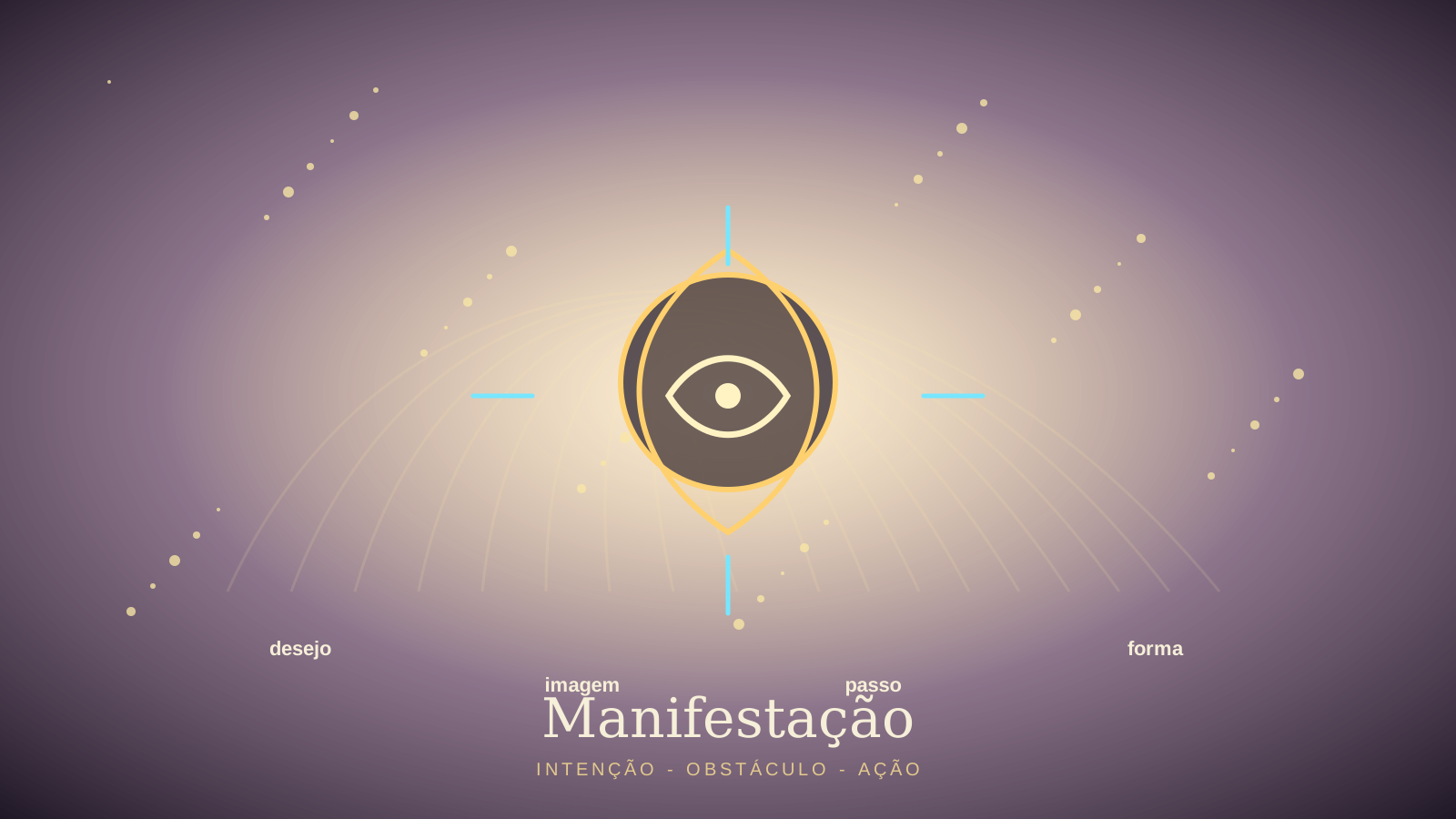
A mature practice may follow four movements. First, listen to desire without hurry. Second, turn desire into a clear but flexible image. Third, contrast that image with real obstacles. Fourth, create next steps small enough to happen.
This sequence joins spirituality and ground. Intention gives direction. Image gives form. Obstacle gives truth. Step gives body. Without intention, action disperses. Without obstacle, intention fantasizes. Without step, manifestation becomes mental decoration.
The final question is not will the universe deliver? It is: am I willing to participate in the delivery with presence, courage, adjustment and responsibility?
Critical reading
Manifestation should be read as a process of embodiment: desire, image, obstacle, choice and form. Its value lies in bringing intention and concrete life together; its risk lies in selling total control of reality or denying real suffering.
References and starting points
- Britannica - New Thought
- Britannica - New Age movement
- PMC - Mental contrasting as a tool for behavior change
- PMC - Implementation intentions and goal achievement
- Psychwire - Gabriele Oettingen on motivation
- Encyclopaedia Britannica - Self-efficacy
FAQ
Is manifestation the same as the Law of Attraction?
Not exactly. The Law of Attraction is a doctrine about like attracting like. Manifestation is the broader process of giving form to an intention, with or without belief in a literal cosmic law.
How can one manifest without falling into fantasy?
By joining desire to reality: clarifying intention, visualizing flexibly, recognizing obstacles, creating small actions and revising the path as life responds.
Keep exploring


Join the conversation
Comments are moderated. Keep the discussion respectful and distinguish evidence, interpretation and personal experience.